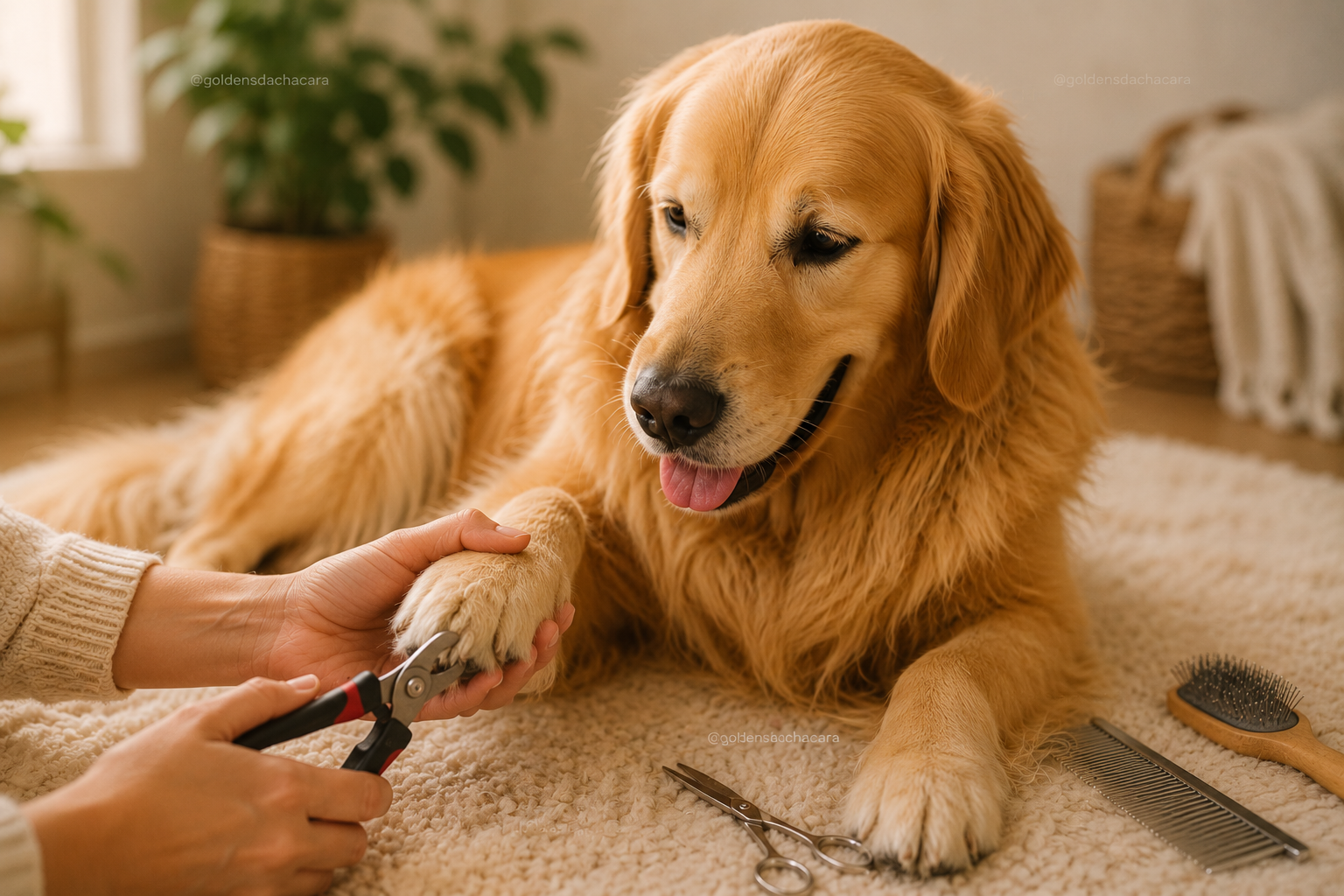
Dog Nail and Paw Hair Trimming: How to Get Your Pet Used to It
Does your dog get scared when you trim their nails or paw hair? Learn how to get your pet used to it gradually with patience, treats, and positive reinforcement.
Trimming your dog's nails and the hair around their paws may seem like a simple task, but for many pet owners, it can be quite a challenge.
Some dogs don't like having their paws touched, try to pull them away, become restless, or even show fear when they realize their owner is going to trim their nails or paw hair.
If this happens with your dog, know that you don't have to try to do everything at once.
With patience, consistency, and positive reinforcement, you can help your dog become more comfortable during these grooming routines.
That's exactly what I started doing with my 6-year-old Golden Retriever, who has always been quite afraid of this type of care.
Start Slowly
If your dog doesn't like having their paws handled, the first step doesn't have to be trimming their nails.
Instead, it's better to start by simply helping them get used to being touched.
Choose a time when your dog is calm and gently touch their paws. Hold one paw for a few seconds, give it a gentle massage, and then let go.
At first, your dog may try to pull their paw away. And that's okay.
Don't turn the moment into a struggle. If your dog becomes uncomfortable, stop, let them calm down, and try again later.
The idea is for your dog to gradually learn that having their paws handled doesn't necessarily mean something bad is going to happen.
Just a few minutes a day can make a difference.
Use Treats to Create a Positive Association
One thing that can help a lot during this process is using treats as a reward.
Whenever your dog allows you to touch their paw, hold it for a few seconds, or stays calm during grooming, reward them.
It can be a small treat, some affection, or even praise in a happy voice.
The goal is to help your dog associate this moment with something positive.
At first, you don't even need to successfully trim a nail.
If your dog simply allows you to hold their paw without trying to escape, that can already be considered progress.
As the days go by, you can gradually increase the amount of time you handle their paws and move on to the next step.
Introduce the Nail Clippers Gradually
Once your dog is more comfortable with you handling their paws, it's time to introduce the nail clippers.
You don't need to pick up the clippers and immediately start trimming every nail.
First, let your dog look at and sniff the clippers. You don't need to use them right away.
Next, you can gently touch the clippers to the nail and reward your dog if they remain calm.
Repeat this process as many times as necessary.
When your dog seems more comfortable, try trimming only the very tip of one nail.
If they handle it well, praise them and give them a reward.
There is no need to trim all the nails in one day.
One nail today, two tomorrow... small steps are still progress.
Don't Force Your Dog If They Are Scared
This is one of the most important parts.
If your dog is very nervous, trying to escape, trembling, growling, or showing clear signs of fear, don't force the procedure.
Continuing when your dog is extremely uncomfortable can make them associate grooming with an even more negative experience.
The goal isn't simply to finish the trim.
The goal is for your dog to gradually become more comfortable with the process.
Every dog has their own personality and their own pace when it comes to adapting. So be patient.
How to Trim the Hair Around Your Dog's Paws
In addition to the nails, the hair around your dog's paws also needs attention, especially in breeds with a lot of fur, such as Golden Retrievers.
Before trimming, it's important to brush the area well to remove tangles.
On the bottom of the paw, you can carefully trim the excess hair that grows between the paw pads.
On the top of the paw, one technique I am learning and putting into practice is using a brush or comb to pull the hair backward.
Then, trim only the excess.
After that, comb the hair downward again and look at the shape of the paw.
If there is still some excess hair, make small adjustments.
This approach helps create a cleaner and more natural-looking finish without removing too much hair at once.
Trim a Little and Adjust as Needed
One tip I've learned during this process is: don't try to make the paw look perfect all at once.
It's much easier to trim a little, comb the hair, take a look, and then remove a little more if necessary.
After all, once you've cut too much, you can't put the hair back.
Making small trims also helps you avoid overdoing it and allows you to gradually understand the natural shape of your dog's paw.
My Experience With My Golden Retriever
This advice isn't based only on something I'm studying. I'm also learning and putting it into practice here at home.
I have a 6-year-old Golden Retriever who has always been quite afraid whenever we needed to handle his paws and nails.
For a long time, I took him to a pet grooming salon for these things, mainly because I was afraid of hurting him or not being able to do it correctly.
Over time, I started studying more about dog care and paying closer attention to his behavior.
Instead of trying to do everything at once, I started slowly.
First, I handled his paws. Then I gave him massages and offered treats. Little by little, I introduced the grooming tools and started trying small grooming tasks.
Today, I am able to trim his nails and the hair around his paws at home.
I'm still studying and learning, so I am not a professional groomer. I'm simply sharing my experience because I know that many other people are also afraid to try these types of grooming routines at home.
And if I was able to make progress with a dog who has always been afraid, perhaps these small changes can help you and your pet too.
Be Patient With Your Dog
If you're also afraid to trim your dog's nails or paw hair, you don't need to learn how to do everything at once.
Start with a few minutes.
Touch their paw.
Give them a massage.
Offer a treat.
The next day, do it again.
Then, introduce the nail clippers.
Once your dog is more comfortable, try trimming just the tip of one nail.
Go slowly and respect your dog's pace.
Don't worry if, at first, you can only do a little. The important thing is to build trust and help your dog understand that this doesn't have to be a scary experience.
You also don't need to compare yourself to videos online where grooming is done very quickly. Every dog is different, and some dogs need much more time to become comfortable.
When Should You See a Professional?
Even with training and patience, some dogs may continue to strongly resist grooming.
If your dog tries to bite, becomes extremely agitated, or shows intense fear, it may be better not to continue on your own.
Look for a professional dog groomer or talk to your veterinarian for guidance on the best way to handle these grooming needs.
It's also important to remember that trimming nails requires care, because there is a blood vessel and nerve supply inside the nail. Cutting the wrong area can cause pain and bleeding.
So, if you don't feel confident doing it yourself, there is absolutely nothing wrong with leaving this part to a professional while continuing to work on your dog's comfort and trust at home.
Small Steps Make a Difference
Looking back today, I realize that I was afraid too.
I was afraid of cutting incorrectly, hurting him, or having him refuse to cooperate.
But I started studying, observing, and trying things little by little.
And it was precisely when I stopped thinking that I had to accomplish everything in a single day that things started to become easier.
Maybe today you can only hold your dog's paw for a few seconds.
And that's okay.
Tomorrow, it might be a few seconds longer.
Then, maybe one nail.
Then, two.
With patience, treats, affection, and plenty of calm, something that once seemed impossible can eventually become part of your routine together.
In the end, more than simply being able to trim your dog's nails or paw hair, the most important thing is building trust between you and your dog.
💡 Important tip: Start slowly: handle your dog's paws, give gentle massages, and offer treats when your dog stays calm. Then introduce the nail clippers and try small trims while always respecting your pet's pace.